What a JEPA predicts
A mask sampler splits the token grid into a visible context and one or more target blocks. The context encoder computes only the visible tokens, which is where the speedup over reconstruction comes from: masked positions cost nothing, because they are never in the sequence at all.
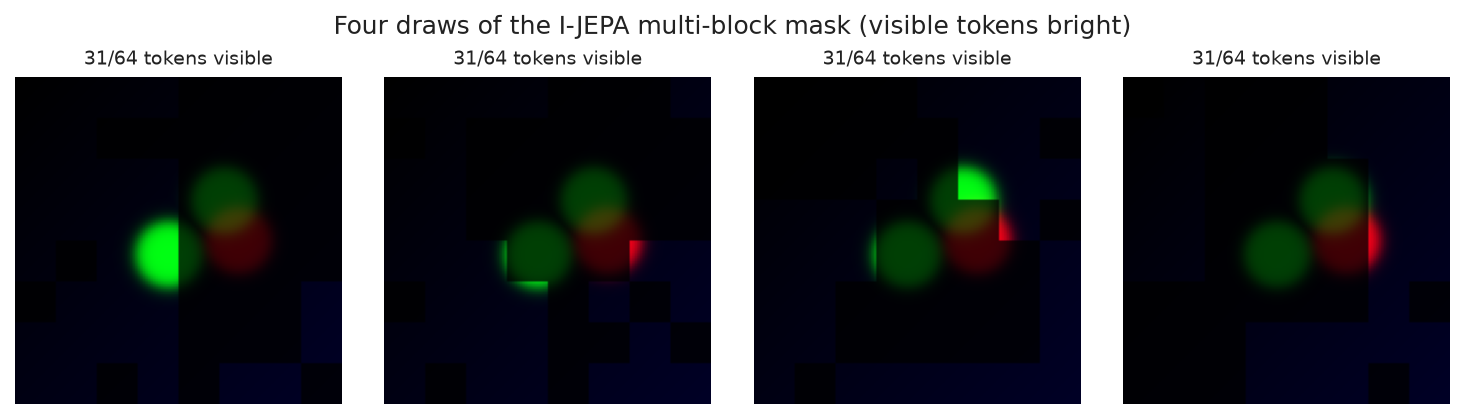
MultiBlockMask2d over one 2-D grid.
Each draw yields one context and several target blocks.
The samplers
| sampler | used by | idea |
|---|---|---|
MultiBlockMask2d |
I-JEPA | large 2-D blocks, too big to interpolate from neighbours |
TubeMask3d |
V-JEPA | a spatial region extended through time, so no visible frame contains the answer |
TemporalSplit |
V-JEPA 2-AC | see a prefix, predict whole future frames |
RandomMask |
baselines | uniform random tokens |
Every sampler returns a MaskBatch:
mask.context   # (K_ctx,)     int32 indices the encoder may see
mask.targets   # (M, K_tgt)   int32 indices to predict, one row per block
Several target blocks per draw let one context encoding be reused for several prediction problems, which is where most of I-JEPA's efficiency comes from.
Why the block has to be big
A small mask is not a prediction problem: a 4×4 hole in a natural image is
recoverable by interpolating its neighbours, and a model that learns to
interpolate has learned a low-level smoothness prior rather than anything about
the scene. target_scale=0.15, which is 15% of the grid per block, is large enough that
local continuation does not suffice.
The same argument in time is why TubeMask3d extends a spatial region through
frames rather than masking pixels per frame. If a region is visible in frame 3, a
model can copy it into masked frame 4 and score well without modelling motion at
all. A tube removes that shortcut: no visible frame contains the answer.

TubeMask3d: one spatial region, held across every frame of the clip.
Short- versus long-range
Two presets trade the number of prediction problems against their difficulty:
sampler = xwm.masking.short_range_tubes(grid)   # many small tubes
sampler = xwm.masking.long_range_tubes(grid)    # few large tubes
Measured on 128×128×8 clips over 4000 steps (findings):
| preset | tubes | tokens/tube | context | loss | rankme |
|---|---|---|---|---|---|
| short-range | 8 | 36 | 69 | 0.451 | 15.1 |
| long-range | 2 | 100 | 86 | 0.273 | 22.7 |
The long-range preset has the lower loss and the higher effective rank. Fewer, larger tubes leave a larger context, so each individual prediction is better supported, and the representation that supports it is richer.
Masks are batch-shared and statically shaped
Two properties that matter for compilation:
- Batch-shared. One draw applies to the whole batch. Per-sample masks would give each element a different sequence length.
- Statically shaped. Block sizes are fixed at construction, so
contextandtargetshave the same shape on every step and a training step compiles once.
Sampling is combinatorial host-side work (rejection sampling for non-overlapping
blocks), so it happens in model.prepare_batch(), outside jit. The
Trainer calls it for you:
Never let a target token into the context
The tests assert this for every sampler, because it is the one bug that makes a JEPA look excellent and teach nothing: if the answer is visible, the predictor learns to copy.
Sampling a mask directly
import jax.random as jr
import xwm

grid = (8, 8)
sampler = xwm.masking.MultiBlockMask2d(grid, n_targets=4, target_scale=0.15)
mask = sampler(jr.PRNGKey(0))

z_context = model.encoder(image, keep=mask.context)     # only 85% of the grid
z_target = xwm.masking.gather(all_tokens, mask.targets[0])
complement,
subsample and
frame_indices cover the
index arithmetic you would otherwise write yourself.