
qjax
Tsallis statistics for artificial intelligence, built on JAX — q-deformed entropies, distributions and activations as pure, differentiable functions, with an entropic index you can learn by gradient descent.
Why qjax
Tsallis (non-extensive) statistics generalizes Boltzmann–Gibbs–Shannon statistics through a single entropic index \(q\). As \(q \to 1\) every construction collapses back to its classical counterpart — Shannon entropy, the Gaussian, softmax, the Kullback–Leibler divergence — while \(q \neq 1\) opens up heavy tails, sparse attention, and tunable exploration.
qjax exposes these \(q\)-deformed primitives as pure, differentiable,
jit/vmap-friendly JAX functions. Because \(q\) is just another argument, you
can hold it fixed or learn it end-to-end by gradient descent.
import jax, jax.numpy as jnp
import qjax

qjax.q_log(2.0, q=1.5)                                  # q-logarithm (-> log as q -> 1)
qjax.tsallis_entropy(jnp.array([.5, .3, .2]), q=2.0)    # -> Shannon as q -> 1
qjax.tsallis_entmax(jnp.array([2., 1., -1.]), q=2.0)    # sparsemax (sparse softmax)

# q is differentiable — learn it end to end:
jax.grad(lambda q: qjax.q_gaussian_logpdf(0.5, q, 1.0))(1.5)
What is inside
Installation
Install with uv or pip, the optional extras, and the GPU/TPU note.
Quickstart
Every primitive in one runnable page, from q_log to a learnable q.
Examples
Thirteen runnable scripts — five of them statistical physics, each checked against an exact reference value.
API reference
Generated from source docstrings, so it always matches the installed version.
Primitives and their q → 1 limits
Every primitive is defined by a single closed form in the entropic index \(q\), and each recovers its Boltzmann–Gibbs–Shannon counterpart in the limit \(q \to 1\).
qjax |
Definition | Limit \(q \to 1\) |
|---|---|---|
q_log |
\(\ln_q x = \dfrac{x^{1-q} - 1}{1 - q}\) | \(\ln x\) |
q_exp |
\(\exp_q x = \big[1 + (1-q)\,x\big]_+^{\frac{1}{1-q}}\) | \(e^{x}\) |
tsallis_entropy |
\(S_q(p) = \dfrac{1 - \sum_i p_i^{\,q}}{q - 1}\) | \(-\sum_i p_i \ln p_i\) |
tsallis_cross_entropy |
\(H_q(y, p) = -\sum_i y_i \ln_q p_i\) | \(-\sum_i y_i \ln p_i\) |
tsallis_divergence |
\(D_q(p \,\Vert\, r) = \dfrac{\sum_i p_i^{\,q}\, r_i^{\,1-q} - 1}{q - 1}\) | \(\mathrm{KL}(p \,\Vert\, r)\) |
q_gaussian_pdf |
\(\mathcal{G}_q(x) = \dfrac{\sqrt{\beta}}{C_q}\,\exp_q(-\beta x^2)\) | \(\sqrt{\tfrac{\beta}{\pi}}\,e^{-\beta x^2}\) |
tsallis_entmax |
\(\operatorname{entmax}_q(z) = \displaystyle\arg\max_{p \in \Delta}\,\langle p, z\rangle + S_q(p)\) | \(\operatorname{softmax}(z)\) |
Here \([\,\cdot\,]_+ = \max(\cdot, 0)\) is the Tsallis cut-off, \(C_q\) the
\(q\)-Gaussian normalization, and \(\Delta\) the probability simplex. At \(q = 2\),
tsallis_entmax is exactly sparsemax.
Highlights
- Differentiable in \(q\). The entropic index is finite everywhere, including
the \(q = 1\) limit, so
jax.gradflows through it — \(q\) can be learned. - JAX-native. Pure functions, composable with
jax.jit,jax.vmap, andjax.grad. - Tested at the limit. The suite verifies the \(q \to 1\) recovery, gradients,
and
jit/vmapbehaviour of every primitive. - Publication-grade plots. A brand-ramp Matplotlib style and helpers that export vector PDFs.
- Physics with exact references.
qjax.physicspairs the primitives with the systems they describe — the 2-D Ising model, the Sherrington–Kirkpatrick spin glass, Lennard-Jones clusters, anomalous diffusion — each with a closed form, an exhaustive enumeration, or a published value to be checked against.
Research library
qjax is a research project. The numerics are well tested, but the API may
still evolve between releases.
Example: label-noise robustness
When training labels are noisy, ordinary softmax cross-entropy is unbounded — a confidently mislabeled example incurs an arbitrarily large loss, so an over-parameterized network ends up memorizing the noise. Replacing the logarithm with the deformed \(q\)-logarithm gives the Tsallis cross-entropy, which is bounded for \(q < 1\): its gradient saturates on unfittable points, so the model ignores label noise instead of fitting it.
For a one-hot target with true class \(c\) and softmax probabilities \(p\),
As \(q \to 1\) this is exactly the standard cross-entropy \(-\log p_c\); for \(q < 1\) the per-example loss is bounded above by \(1/(1-q)\), so mislabeled points cannot dominate the gradient.
The figure trains a small 3-class classifier on two shapes (blobs, spiral) from clean data up to 40% label noise, comparing the Boltzmann–Gibbs–Shannon baseline (\(q = 1\)) with Tsallis (\(q = 0.3\)). The comparison is fair — both share the same initialization, data, noisy labels and optimizer; only \(q\) differs. Without noise the two match (≈98–99%); as noise grows the baseline carves spurious wrong-class islands while Tsallis keeps clean regions and higher accuracy.
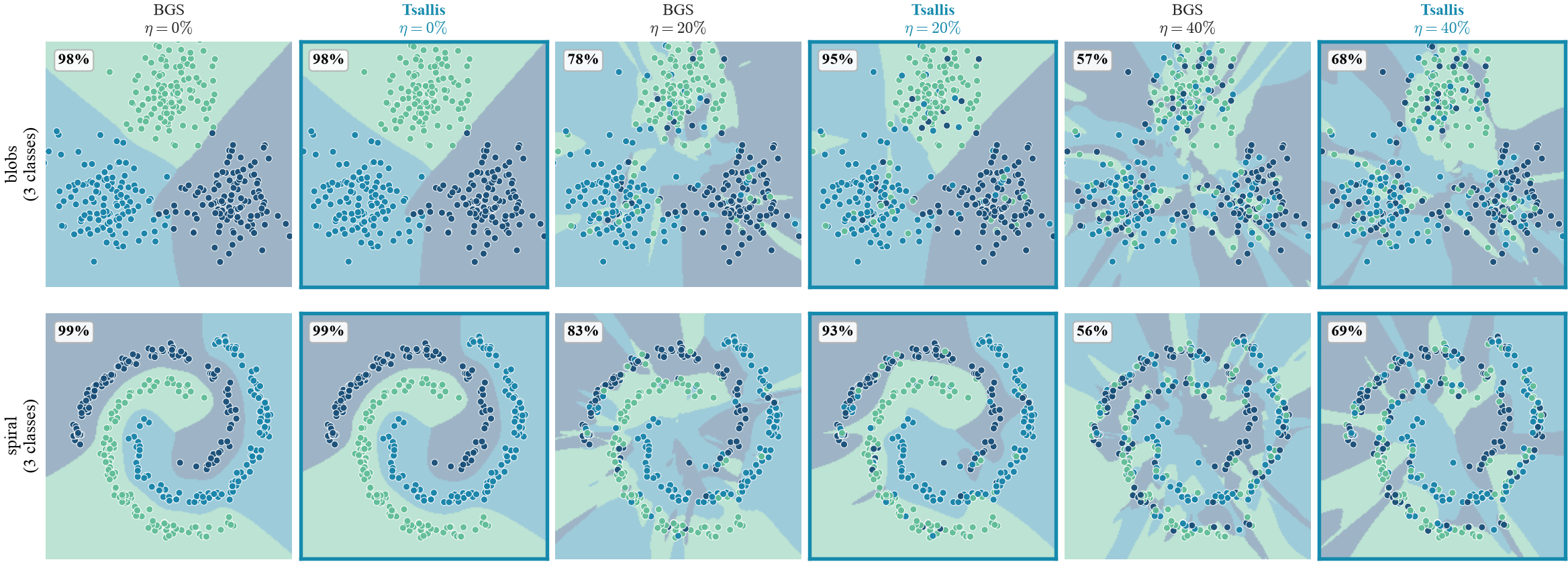
Decision regions at 0%, 20% and 40% label noise; the Tsallis (robust) columns are framed in teal. See the classification example for the full setup.
What's inside the package
| Module | Contents |
|---|---|
qjax.core.functions |
q_log, q_exp, and the \(q\)-algebra (q_add, q_diff, q_prod, q_div) |
qjax.core.entropy |
tsallis_entropy, tsallis_cross_entropy, tsallis_divergence |
qjax.core.distributions |
the \(q\)-Gaussian: q_gaussian_pdf, q_gaussian_logpdf, sample, normalization |
qjax.core.activations |
tsallis_entmax (the \(q\)-deformed softmax / sparsemax family) |
qjax.nn |
framework-agnostic pieces: bounded_q, attention, losses |
qjax.plots |
brand-ramp, publication-grade plotting helpers |
Next steps
- Get started — Installation and Quickstart.
- Understand the math — Theory.
- See it in action — Examples.
- Look up a function — API reference.